Does positioning a katana as wall art expand your non‑enthusiast customer base?
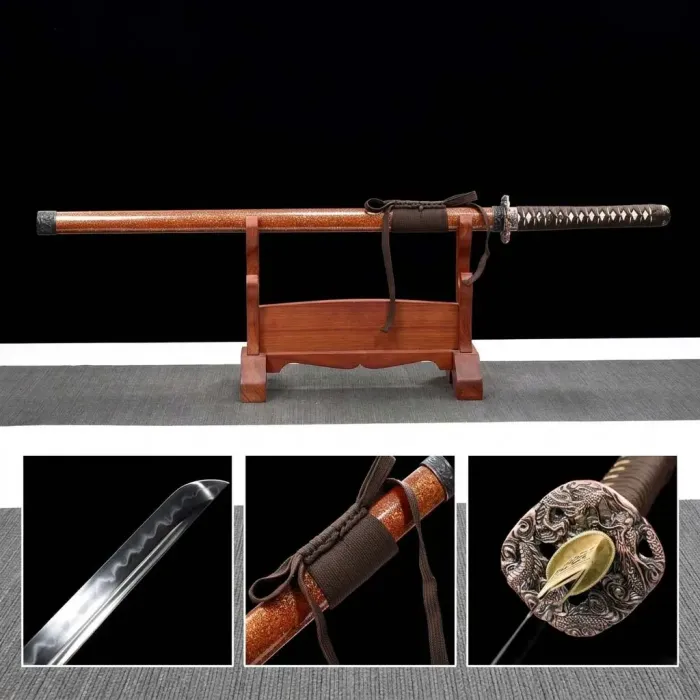
This customary samurai blade stands a magnificent example of fabrication, but how about you strive for to show your own style? Personalizing your weapon is a profound journey, allowing you to assemble a truly exceptional piece. From the grasp wrapping and collar to the shield design and hamon, each component offers a chance for unique expression. This analysis delves into the area of katana adjustments, providing facts for both beginners and proficient enthusiasts desiring to leave their footprint on the long-standing art of the samurai.
Newcomer's Legitimate Mastery
For those prepared to embark on the enriching journey of martial arts involving swords , 1060 steel katanas supply an remarkable entry point. This specific grade of tool steel balances a fine equilibrium between affordability and proficiency. While never as hard as upper-echelon steels, 1060 facilitates a fair level of fine tuning , making it beneficial for beginners to practice the core principles of weapon preservation and value the appeal of artisanal Japanese weaponry. It’s a first-rate choice for obtaining experience without the pecuniary burden of more enhanced steels.
Grade T10 Cutlasses: Combining Performance and Affordability
For enthusiasts seeking an authentic cutting instrument experience without crossing the financial plan, T10 composition katanas represent a inviting option. These cutlery offer a distinct improvement in strength compared to budget alternatives, exhibiting fair edge retention and suitable flexibility for introductory cutting techniques. While not rivaling the exquisite characteristics of ultimate steels like T100 or folded iron , T10 provides a notable blend of ability and affordability , making them a popular choice for trainees and those on a controlled earnings .
Transcending the Blade : Enhancing Your Edge's Components and Grip
Despite the honed blade is undeniably the important point of a katana, truly amplifying its aesthetic lies in the exact customization of its accessories and handle . This operation allows craftsmen to demonstrate their unique design . Explore the sweeping possibilities: menuki - decorative ornaments that enhance visual beauty ; the hamon wrappings – often elaborately crafted ; the tsuka essence itself, wrapped in authentic ito binding ; and the fusa end piece , which can be designed from various components like gold or tusk .
- Select designs that resonate with you.
- Assess with varying resources .
- Emphasize strength for a lasting influence .
The Appeal of the Katana: Tradition, Creation, and Alloy
Each Japanese sword contains a matchless allure, steeped in epochs of Asian history and ancestry. More than merely a implement of military action , it's a representation of the knight ethos – a fusion of prowess and self-control . Its growth spanned plentiful generations, with early blades evolving into the refined curvature and sharp edge we accept today. The craftsmanship involved is truly exceptional , requiring ages of coaching to master . The process involves a involved folding of refined metal , creating layers that fortify the instrument’s flexibility and slicing ability. Diverse schools of crafting appeared , each with their separate secrets and techniques for achieving the ultimate poise and acuteness - a truly grueling pursuit.
- Original Katana styles
- The importance of the traditional blade in samurai culture
- Ancient forging techniques
Picking the Appropriate Steel for Your Cutting Tool Project: 1060 vs. T10
Opting for the ideal steel is vitally important for any cutting weapon project, and the determination between 1060 and T10 can be difficult. 1060 is a favored American material, offering a reasonable balance of durability and robustness, allowing it fairly easy to heat treat. However, T10, a Japanese steel, commonly boasts amplified t10 steel katana wear permanence and can probably achieve a enhanced conclusive hardness, although it can be markedly troublesome to handle and requires precise heat refinement. Consider your qualification and expected effects: for a first-timer, 1060 may be a easier origin, while the expert smith might value the supplementary qualities of T10.
- Ease of Applying
- Friction
- Peak Hardness
Unleashing the Power: High-Level Katana Modification Methods
Excelling in the craft of sword improvement extends far beyond basic finishing. Serious practitioners are now analyzing advanced techniques to truly discover a blade's hidden potential. This entails intricate work with the heat signature, utilizing specialized products for differential heat treating and carefully nominating the contour of the hand guard to optimize balance and functionality. Beyond purely functional modifications, artisans are increasingly focused on realizing unparalleled aesthetic style, through complex engraving and layered films that truly transform a katana into a creation.
Transforming Basic Steel into Art: Building a 1060 Sword
The journey initiates with standard 1060 fabrication , a durable material far absent the polished katana it will shift into . Experienced bladesmiths carry out a intricate process of integrating and forging the rough steel, repeatedly glowing it and beating it to rid impurities and produce a homogeneous grain structure. This time-consuming process, often continuing for intervals , builds the necessary sturdiness and adaptability characteristic of a genuine Japanese armament . Follow-up heat methods , including meticulous hardening and resting, are vital to achieve the preferred equipoise of sharpness, longevity and attractiveness .- Integrating: Lessens impurities and builds grain structure.
- Crafting: Creates the steel into the initial blade form.
- Heat Treatment: Sets the final hardness and flexibility.
The Enduring Appeal of the Katana: A Deep Dive into Steel and Customization
An historic katana holds present a intense symbol denoting Japanese culture , its allure far exceeding mere armaments . Forged from rare steel and habitually featuring intricate details , the system of creation itself is a sacred art. Beyond the fundamental craftsmanship, the ability to customize a katana - from the blade pattern to the handle wrapping and band - permits for a authentically individual manifestation for both devotees and operators alike. This union of legacy steelwork and boundless personalization effectuates the katana's continued prestige across the terra .
